Central Department of Journalism and Mass Communication
KMC Ward 14, Balkhu
KMC Ward 14, Balkhu
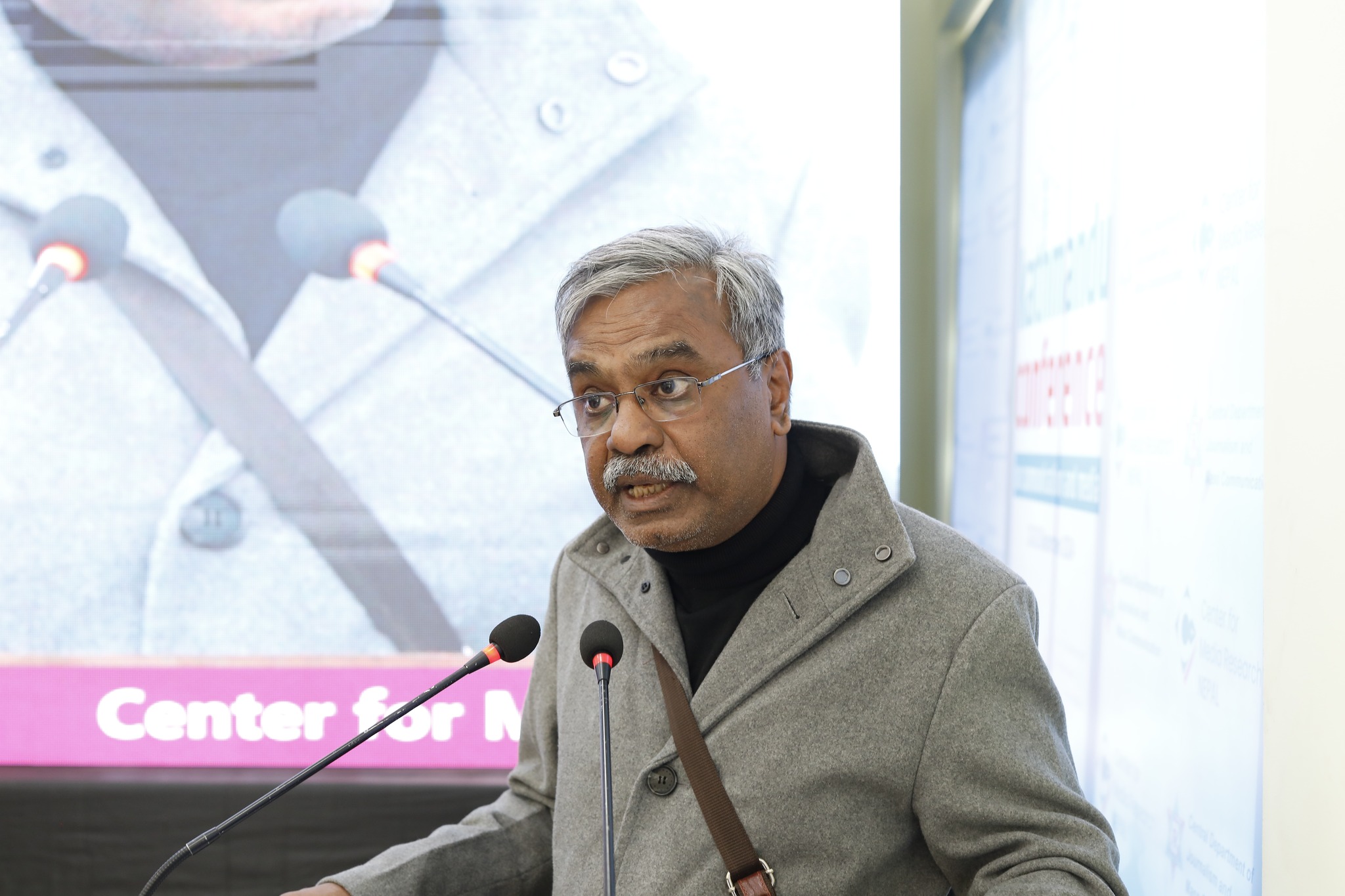
Anil Chamadia , Media Studies Group ,New Delhi
Why are we discussing how Indian media reports on SAARC countries? SAARC is group of countries that include Afghanistan, Pakistan, Bangladesh, Nepal, Maldives, Sri Lanka, Bhutan and India. Therefore, we are also discussing how Indian Media’s reporting is portraying India. While we can see that, some SAARC countries have turned democratic few years back and in others the process to strengthen democracy seems to be obstructed. India is said to be world’s largest and oldest democracy. Indian Prime Minister also presses on the fact that India is Mother of democracy.
Looking at different SAARC countries, we witness that Bangladesh, Pakistan and Afghanistan have had religion based military rule. Bhutan is a constitutional monarchy while Maldives and Sri Lanka have faced democracy deficit in recent years. After the beginning of the quest for new global order in 1990, Nepal’s monarchy was dissolved and the country became a democracy and since then has been struggling to strengthen its democratic system.
It is said that to judge the degree of democracy in a country it is imperative to observe how the medium of freedom of expression, which is also called the fourth pillar of democracy, behave towards those in power as well as the general population. Indian Media therefore, becomes important for SAARC countries because its favourable or unfavourable reporting on neighbouring countries is considered to judge the degree of democracy in these countries.
What is Media?
Media can be divided into two broad platforms–commercial and non-commercial. Generally, the commercial media is described as Media. What we are discussing in the Indian context are better known as Media companies. Times of India is India’s biggest media house. Vineet Jain, the managing director, claims in an interview with The New Yorker on 8th October 2012, that he is actually not in the newspaper but rather in advertising business.
Constitutions of many countries guarantee Freedom of speech and expression as a basic right of citizens, but ironically, medium of the Freedom of expression are in the hands of few media companies. These companies have maximum control in different communication medium like newspaper, magazines, Tv channels, radio channels and news websites and portals.
Even before 1947, Saheed-e-Azam Bhagat Singh and Dr. B.R. Ambedkar raised a critique of these media companies. Bhagat Singh, writing in the magazine Kirti in 1928, pointed to the role of media companies in inciting communal violence for business interest. There have been many studies, conducted in India, on the role of media during communal violence. During 1943, Dr. Bheem Rao Ambedkar described how the media is completely in the hands of big businessmen and how they try to control the politics of the country. He said, “ news gives place to sensation, reasoned opinion to unreasoning passion, appeal to the minds of responsible people to appeal to the emotions of the irresponsible” is what journalism stands for today. He harboured this idea even for undivided India. This is what still holds true today even after India had been divided into Pakistan in 1947 and further Bangladesh in 1971.
After 1947, Indian planning commission under the leadership of P.C Mahalanobis presented a report on 25 February 1964 before the government of India. The report mentioned “ Economic power is exercised not only through control over production, investment, employment, purchases, sales and prices but also through control over mass media of communication. Of these, newspapers are the most important and constitute a powerful ancillary to sectoral and group interests. It is not, therefore, a matter for surprise that there is so much inter-linking between newspapers and big business in this country, with newspapers controlled to a substantial extent by selected industrial houses directly through ownership as well as indirectly through membership of their boards of directors. In addition, of course, there is the indirect control exercised through expenditure on advertisement which has been growing apace during the Plan periods. In a study of concentration of economic power in India, one must take into account this link between industry and newspapers which exists in our country to a much larger extent than is found in any of the other democratic countries in the world.” There are many reports, both government and non-government, that provides a thorough analysis of the monopoly of companies over media. In 2001, Press Council of India, in one of its publication, presented fact-based information on the ill-effect of monopoly in media on democracy.
Press Council of India also says that in a democratic country like ours , a majority of the media be it newspaper ,magazine or electronic media are run by private individuals. The second press commission (P.1454-146) in India writes that “the newspaper industries ( now Media) in the big business hand becomes involuntarily the cultural arms of other business and industries, and takes a vested interest in maintaining the existing socio-economic system. The newspaper controlled by them may be selective in their presentation of news
and views in return for benefits conferred in respect of other business interest.
When we are looking at the relationship between democracy and Indian media companies, we must understand that the conclusion drawn from these analysis is not an isolated one. Parallel can be drawn in Pakistan as well. Syed Irfan Ashraf, Syed Hussain Shaheed Soherwordi and Tabassum Javed wrote in their book titled The Dark Side of Journalism "The political economy of media not only looks into power from ownership perspective but also explain news in top-down decision-making order. The writers are providing insight into macro-level developments in Pakistan i.e., commercialization of media and the concentration of media to serve interests of those ruling at the top”.
We have seen this trend in Nepal as well. It is clear that similar to developed countries, the media companies in SAARC nations have expanded the ways in which they can become more important for democracy. These companies can be working in a particular nation but more often than not, they are related to media companies of international level. It can be said that in the new economic system, every company is of global nature. Here we are talking about the journalism that the these companies are doing in democracies.
The Impact of Media Monopoly by Companies on the Entire Media Structure
These developments have raised concerns about the independence and diversity of the media in the SAARC region, particularly in terms of how information is gathered and distributed. The concentration of media ownership and the erosion of editorial independence have significant implications for journalistic integrity and the free flow of information.
3) The Trend of Confirmation Bias
The tendency to confirm or cross-check news has nearly vanished in media companies. In India, on 23rd April 2022, the Ministry of Information and Broadcasting issued a notice regarding foreign news. This notice specifically addressed the broadcast of content related to the war between Russia and Ukraine on Indian Hindi television channels. Russia also expressed its objections. In fact, the sense of responsibility towards foreign news has significantly diminished.
As Syed Irfan Ashraf and others point out, news from conflict zones is often presented in a way where the first version of events tends to prevail over all subsequent "truths." The events in such zones are so dramatic and traumatic that commercial media cannot afford to be left behind by competitors. This explains the significance of social media in every newsroom, where speed often trumps accuracy.
In 1970, the MacBride Commission highlighted the issue of a "one-sided flow of information." However, today, we can observe that the monopoly of large capital has created a situation where news is used as a tool for attacks in the context of global power dynamics. This monopoly, driven by commercial interests, has led to a highly skewed and often biased flow of information, especially in global conflicts.
The drive for profit and competition in the media industry often leads to sensationalism, with less regard for the accuracy and authenticity of the information being presented.
Inspiration for Discussing Media Journalism in SAARC Countries
What could be the objectives of media companies in one country while reporting on foreign countries? If we look at the declared objectives of media companies, their concern is to make readers, viewers, and listeners aware and to connect them with events happening in the country and the world. They claim that information educates. But is that really the case?
I often visit journalism teaching and training institutes in India. I have also spent three years at one of India's oldest institutes, IIMC, teaching hundreds of students. When I became concerned about the lack of knowledge journalism students had regarding SAARC countries, I planned a study on the media of SAARC countries at Delhi University. I found that the students in the classroom were lacking knowledge about SAARC and its media. I then gathered information from the students about the media of SAARC countries and published a paper.
Mahatma Gandhi is closely associated with Wardha in Maharashtra, and while working as a professor at the International Hindi University there, I felt it was essential to assign similar work to students. Students felt energized and empowered by gaining knowledge about the media of neighboring countries, something I experienced as a teacher. This created awareness about what was being reported about SAARC countries in Indian media companies. However, people like us are often considered temporary figures.
During my journalistic work, I felt the need to create a platform to strengthen relationships between journalists of SAARC countries, so there could be dialogue among journalists in India. But a permanent foundation could be laid at the academic level, and that area is research. I proposed that a research student study the media of India and Pakistan. The methodology would be to analyze how select events were reported by the media of both countries. How much journalism was there, and how much did nationalism dominate the narrative? How can the same event be presented differently under the guise of religion and nationalism?
Why did this idea come to my mind? Because when a group from Pakistan, including some Hindus, came to speak at Jawaharlal Nehru University, I found that the way Pakistani media portrayed India was the extent of their knowledge about India. Similarly, Indian readers, listeners, and viewers only know Pakistan to a limited extent. Here is an interesting example of how a single event was reported differently by the media in Pakistan and India. This concerns the failure of the 2001 Agra Summit between India and Pakistan.
Pakistan’s largest media group wrote: "Advani admits he sabotaged Agra Summit"
(Reference: Dawn).
On the other hand, an Indian media company published a report with the headline: "India's Ex Diplomat Details What Led To Agra Summit Collapse in 2001".
(Reference: NDTV).
The Indian report explained that the collapse of the Agra Summit was due to Pakistan’s then-President Pervez Musharraf's "overreach" in publicly expressing his hawkish views on Kashmir, his lack of intent in addressing terrorism, and his insistence on linking the progress of overall relations with progress on Kashmir. It emphasized that the summit failed not because of LK Advani's hardline stance.
This example shows how the same event was presented with differing narratives based on the perspective of the media in each country.
Media Access and Coverage Between India and Nepal
In India, common readers do not have access to Pakistani newspapers, and similarly, people in Pakistan cannot access Indian newspapers. Both countries' media companies serve their consumers in their own ways and languages. However, this situation does not apply between Nepal and India. In Nepal, Indian newspapers are available, and Nepalese consumers, especially in relation to the 2015 earthquake, have had their share of bitter experiences with TV channels. But what is the perception of Nepal in India? What opinions have been formed about Nepalese people living in India? Such studies do exist.
In India, Nepal is seen as a Hindu nation, and people can still be seen as consumers of companies' journalism. During a research study, I tried to find out how Indian media representatives in Nepal reported about the country. The scope of their reporting has been very limited. A historical context for this can be seen in an article published in 1970 in EPW (14 March 1970, EPW):
"Nepal has been very much in the news, thanks to the 'colourful' wedding of Crown Prince Birendra. All major newspapers thought it a fit occasion to send their own correspondents to Kathmandu. One hopes this is the beginning of a trend and that more and more Indian correspondents will be made available to report Nepal to India. It is customary for some Indian correspondents to accompany the President or the Prime Minister on their tours abroad, and the fact that President Giri went to Kathmandu personally to represent India at the wedding may have had something to do with the actual number of correspondents who visited Kathmandu for the occasion. Regardless, it is a step forward from the general apathy that newspapers have traditionally shown to the question of reporting Nepal. Not many newspapers, for example, have reported anything worthwhile about the move for a conference of Himalayan kingdoms that King Mahendra had planned to coincide with the wedding. Only Organiser seems to have taken more than a casual interest in these developments. The conference in question proved a non-starter as the Chogyal of Sikkim eventually decided not to go and the Druk Gyalpo of Bhutan had never shown any interest in it from the beginning, but the point is that Nepal is an area of close interest for India and needs to be covered more fully by the Indian Press."
This shows that, historically, Nepal's coverage in Indian media has been limited and selective, often tied to specific events or interests.
How Media Companies Set Priorities
Historically, it is well-established that media companies use "political sentiments" to strengthen their position and status. After World War II, the sentiment of nationalism, mixed with religion, grew stronger. Information does not belong to any nation, but the presentation of information is often controlled by a mix of nationalism and religion. Nepal has been a Hindu nation, and its presentation as a Hindu nation in India serves specific purposes.
The struggles of being a religious-based nation are not discussed in the Indian media in the context of Nepal, but they can be seen in the context of Pakistan. In 1990, I discussed the challenges faced by Nepal as a religious-based nation in a booklet. It also addresses India's religious-based politics and, on the other hand, the struggles of the people of Nepal.
I have yet to see a media report about how social development is being observed in Nepal after the acceptance of the secular principle, even though the social development of the 'Nepali Bahadur' is clearly visible. It is generally observed that in neighboring countries, religious minorities and majorities are not referred to as minorities and majorities, but rather as representatives of their religion.
What is the Scope of News in SAARC Countries?
Firstly, the scope of international news for media companies in any country can be defined in the following ways:
Our focus is limited to the reporting of SAARC countries. In this context, what is the foundation of reporting on SAARC countries?
Humanitarian Tragedy/Natural Disasters
Humanitarian tragedies affect neighboring countries as well. However, media companies often focus not on the tragedy itself, but rather on the people affected by the tragedy based on their country, religion, race, or region. The 2015 Nepal earthquake can be seen as an example of this. It provides a perspective to understand the concept of nationalism, which is often shaped by global systems and their underlying foundations.
A report by Annapurna Post claims, referring to sources at the Department of Civil Aviation, that Indian government aircrafts lined up at Kathmandu airport were mostly engaged in airlifting their own nationals. Even in disasters like floods, language is used to highlight the role of neighboring countries in the situation.
The internal conflicts of a country which have an impact on other neighbouring countries.
It is believed that the internal struggles of neighboring countries affect other neighbouring countries as well. However, what seems to be the purpose behind sharing information about these conflicts in the media of SAARC countries? In most cases, these internal conflicts of neighbouring countries are used for domestic purposes. We have seen this in the reporting on issues such as the Tamils in Sri Lanka, the Madhesi in Nepal, as well as in the cases of Bangladesh, Pakistan, Afghanistan, and other countries. The tendency to use the events of neighbouring countries for domestic purposes has already been a practice.
Mr. Samar Sen, editor of the magazine The Frotier, was assistant editor in Anand Bazar Patrika in 1963. The then Chief Minister of West Bengal, PC Sen held a meeting of editors and journalists and requested them not to publish the incidents of communal violence in East Pakistan in such a way that it affects the life of West Bengal people. Mr. Sen agreed and conveyed the opinion of the meeting of the newspapers editors with Chief Minister. But Sen was surprised to find in his newspaper the other day that the incidences of violence and communal conflicts in East Pakistan had been published very prominently.
The tendency of media companies to use relationships with neighboring countries at any level for religious and communal purposes has increased to a great extent. To illustrate this, I can present a couple of examples, keeping in mind the limitation of time.
On January 19, 1998, a sports reporter from The Times of India covered a match between the Indian and Pakistani cricket teams in Dhaka in this manner: “The stadium in Dhaka, where the Indian team achieved a thrilling victory against Pakistan’s 314 runs, is just two kilometers away from Suhrawardy Udyan, where in 1971, Pakistani General Niazi surrendered to General Jagjit Singh Aurora.”
Every language has its own form of journalism. In Hindi journalism, religion and communalism often appear as significant needs. After the India-Pakistan cricket match, an article by Prabhash Joshi, the editor of Jansatta, published on 12 February, 1987, mentions that for Indians, losing to Pakistan feels worse than losing to any other country’s team in any sport. Pakistan believes that the Muslims who ate meat, fish, and eggs, and came from the Khyber Pass, could rule over the Hindus because they were stronger than the hindus who ate simple foods like dal and rice, etc.
Neighboring countries are used in a two-fold manner. On one hand, the internal conflicts of neighboring countries are used for domestic purposes, and on the other hand, the role of neighboring countries in these internal conflicts is highlighted and heavily promoted. The feeling of nationalism becomes an effective tool to deal with the challenges posed by internal conflicts. The rapid rise of this phenomenon in recent years can be studied further.
In reality, journalism in SAARC countries is becoming more confined to borders. Blind nationalism has severely disrupted the concept of borderless journalism, and it has become the biggest obstacle in achieving the goals for which SAARC was established. At present, the media in India is filled with news about Hindus as a minority in Bangladesh. The Bangladeshi government has not accepted the media companies' reporting as accurate. The use of cross-border language to turn internal conflicts into part of an international conspiracy and give them an international perspective is commonly seen. Several important studies have been conducted on this subject, including Ram Narayan Kumar's study on the unrest in Punjab and the role of the media.
Relations with China
Relations between SAARC countries and China have rapidly developed as a basis for media companies' reporting. Especially after the 1990s, following the expansion of China's economy, the relationships between China and countries like Nepal, Sri Lanka, and the Maldives have become a major focus for Indian media companies' coverage. The growing ties between SAARC countries and China have also influenced the language used by media companies.
For instance, when Bhutan declares that it will formulate its own foreign policy, there is a sharp reaction in the Indian media. Similarly, when the Maldives appears to lean towards China, the Indian media's response is not similar to what is expected from a neighboring country.
Political Changes
When there is a political upheaval or a change of power in the SAARC member countries, or during election periods, media companies show increased interest. Specifically, the reporting often focuses on the stance of various political parties towards their relations with India during elections. This aspect of reporting directs the attention to which parties have what kind of approach towards India and its interests.
Questions Before the Media of SAARC Member Countries
If studies of media companies' reporting show that the perspective towards the G-20 is not the same as it is towards SAARC, it raises important questions. The G-20 includes wealthy countries, whereas the purpose of SAARC's formation was to develop a strong social framework, build a relationship of shared values, and promote the identity of South Asian culture.
Academic Responsibilities for SAARC
The South Asian Association for Regional Cooperation (SAARC), established on 8 December , 1985 has eight member countries.The objectives of the Association is: to promote the welfare of the peoples of South Asia and to improve their quality of life; to accelerate economic growth, social progress and cultural development in the region and to provide all individuals the opportunity to live in dignity and to realize their full potentials.
Thanks.